Meeting My Mountain Lion
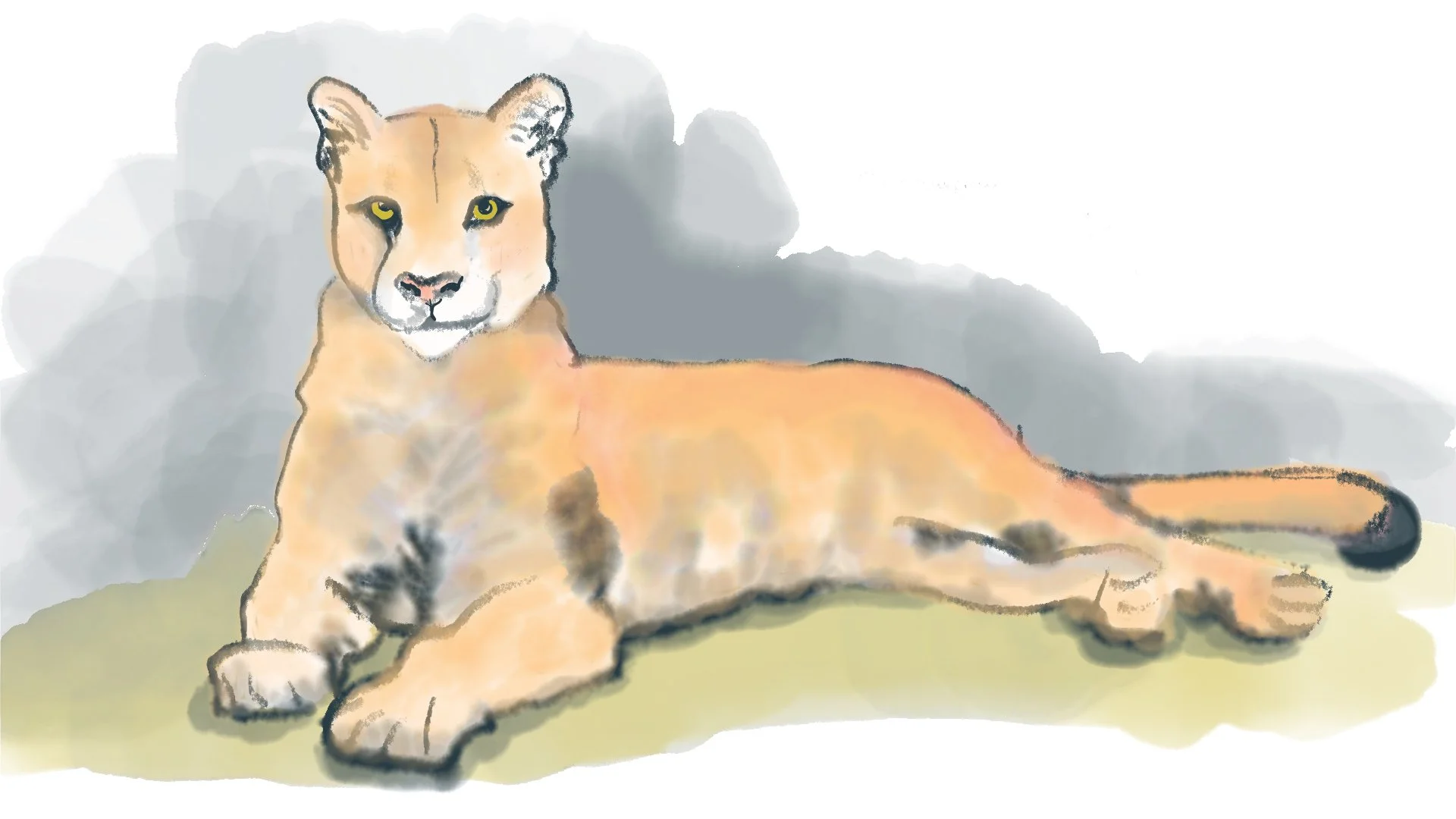
I am genuinely afraid of mountain lions.
Not in a theoretical way. In a trail-runner-in-the-Bay-Area way, which means I have spent years jogging past yellow warning signs with a silhouette of a big cat and the word CAUTION, doing quick math about whether I look like prey. I have never actually seen one in the wild. But the signs are everywhere, and my nervous system has filed them accordingly.
So when I met my power animal in Tutti's guided session, I was not expecting it to be a mountain lion. I was not expecting to feel safe. I was not expecting her to circle me slowly and then lie down and put her head in my lap like she'd been waiting for me.
But that's what happened.
She was female. She was enormous. And before I could be afraid, she looked at me and I understood like a knowing that moved through my body that she was there to help me help others find their fierce.
I sat with that for a long time afterward. I've been afraid of you, I thought. On every trail. For years.
And she just looked at me the way cats do, with that specific quality of patience that has nothing humble in it.
A few days later, an email landed in my inbox from a witch named Ella Andrews. She wrote about a meeting with a powerful man who she envisioned as an old badger, protecting and hoarding his power at the mouth of his den, shooting down every pitch that came his way. When her turn came, she didn't focus on the words. She sent her roots down, called in mountain lion energy, felt it in her body, and concentrated on the tip of her tail — just over her right shoulder — and started to flick it. Like a hunting cat. He funded her campaign.
Her closing line: Power isn't just for the people who already have it. You have it, you can call it in, you can stand firmly in it.
I read it twice. Then I thought about the mountain lion with her head in my lap, and I thought: okay. I see what's happening here.
There's a part of me I've been getting to know more intentionally. She's not loud. She doesn't perform. She holds her ground without drama, chooses her timing, and moves from a place of quiet power rather than fear or reactivity. She is my mountain lion.
I met her during what became one of the more challenging weeks of my professional life.
If you read my earlier post about my 9:29 moment, you know the setup. Internet out. A live workshop with a senior team. No fix possible, no graceful exit, just a sudden collapse of everything I'd prepared. Two days later, same organization, same high-stakes moment, and a leader who was there to see if I could actually deliver. Our internet was still out. I booked a coworking space, walked in, and chose to meet him exactly where he was — not with apology, not with performance, just with honest acknowledgment of his experience.
His energy shifted. The room opened. We did good work.
That was my mountain lion. Still. Grounded. Not hunting, not hiding. Present.
Then, the very next week, I triggered someone I work with and genuinely value. And I did not show up as the mountain lion.
I won't share the details, but what I will say is that I initiated a conversation about something that felt unfair to me, and I did it in writing, and I did it with charged language I know better than to use. I framed my feelings as facts. I hunted in a rainstorm.
This person pushed back. Hard. As people can do when they feel accused.
And here's the thing: the pushback was not wrong. I was honest about what I was feeling. But the way I delivered it invited defense, not dialogue. Writing is a one-way door. Once certain words land, they don't un-land. I know this. I teach this. And still.
What came back felt like a power struggle I hadn't meant to start. There were veiled threats tucked inside reasonable points. There was a closing of ranks that felt personal even if it wasn't. I felt the sting of being called in — and I also knew this person was right to call me in.
So I did the thing I'm most proud of from this whole episode: I owned it.
Not because I agreed with every word of the reaction and response. Not because I'd abandoned my original concern, which remains valid. But because I had led with the wrong energy and caused real harm to a relationship I value, and that deserved a genuine acknowledgment — not a negotiated one.
I said I welcomed the conversation. I recognized how I could have opened it differently. I apologized for the language I'd used. And I meant every word.
That was also the mountain lion. Different stance, same stillness.
The mountain lion is not about winning. She's not about making sure everyone knows she was right. She moves with precision — which means she doesn't strike until the conditions are right, and sometimes the conditions are never right for striking at all. She knows the difference between holding her ground and charging into open ground where she'll be exposed.
Power without attack looks like: asking for a phone call instead of writing an accusation. Sharing a feeling instead of a verdict. Naming what you want for the future instead of relitigating the past. Choosing the relationship over the moment of being right.
I teach resilience. I coach people through hard professional moments. I know — really know — that when you can recognize your stress response, you can interrupt it and choose differently.
That week, I managed it beautifully in one situation and stumbled hard in another.
Both of those are true. I'm not going to make the stumble smaller than it was or the recovery bigger than it was. What I know is that the mountain lion is in me, and she's getting clearer. She showed up at the coworking space to facilitate and hold the room last week. She showed up in the apology that cost me something and was worth it anyway.
She's learning when to move and when to wait. So am I.
Tell me about your mountain lion — or whatever you call that part of you that knows how to hold power without force. I'd love to hear it in the comments.
Always learning,
Tres