A reminder for this week
This week about 81.5 million of us will drive, fly, or ride the train at least 50 miles to sit at someone's table. Flights cost more, the airports had an FAA scare last week, and we arrive a few weeks after the midterms with our group chats still hot. Some of us will walk in braced.
I'm one of the travelers. I'm taking a seven-hour train ride to be with family, which gives me plenty of time to practice what I'm about to preach. Seven hours is long enough to read, nap, watch the landscape change, and share an armrest with a stranger who has strong feelings about the window shade.
A few years ago a Lyft driver named Jose told me his family still gathers every holiday, and no one feels close anymore. Religion, sobriety, politics: all off the table. They kept the peace and lost each other along the way. I think of him every November.
So here's my invitation for this year: take the high road. It asks more of us than silence does, and it leads somewhere better.
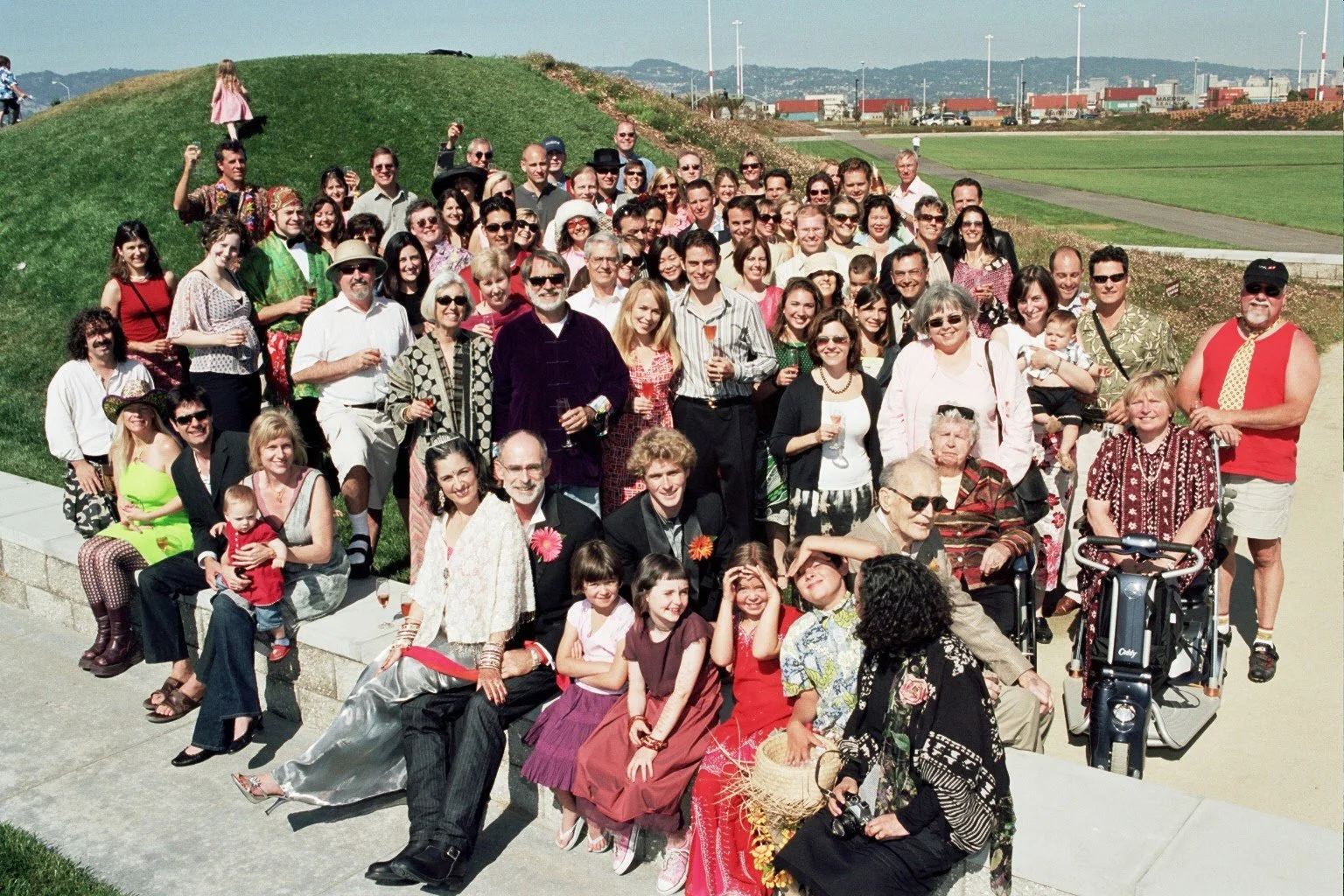
All of the loved ones who came to our wedding in 2004.
Gratitude and grief at the same table
I've stopped calling this week by its usual name. The story many of us learned in school left out what this land and its Indigenous peoples lost, and that harm continues for communities today. Since 1970, Indigenous people and their allies have gathered in Plymouth on this day for a National Day of Mourning. Here in the Bay Area, people meet on Alcatraz at sunrise for the Indigenous Peoples Sunrise Gathering.
I'm still grateful. I'm grateful for my family, my health, my friends, my clients and the people who will cook, clean and keep the trains running this week. Gratitude and grief can share a table. I think of it as a healthy tension: two truths that keep each other honest. If I hold only gratitude, I gloss over harm. If I hold only grief, I lose the joy that keeps me going. The high road makes room for both.
A few ways I'm holding both this year:
Learn whose land you're gathering on. In Oakland and much of the East Bay, that's Ohlone land. You can look up your own address on the Native Land map:
Read or listen to Indigenous voices this week, and share what you learn at the table.
Support Native-led organizations with time or money like I do by paying a land tax every month.
Before the meal, name what you're grateful for and one thing you want to learn more about.
Notice where harm lives in your own family's story too, and where repair is still possible.
Questions to bring to the table:
"What are you grateful for this year, and what's been hard?"
"What did you learn growing up about this holiday? What has changed for you?"
"What tradition do we want to keep, and what do we want to change?"
The high road starts before you arrive
Love and patience don't wait until dinner. They start in the security line, at the gas station, on the train platform. Everyone around you is tired, over budget and trying to get to someone they love. The gate agent didn't cancel your flight. The person reclining their seat is trying to sleep. The family with the crying toddler is having a harder day than you are.
A few things I'm practicing on the road:
Consider that the stranger in front of you is having the same long day you are.
Thank the people working the holiday: conductors, flight attendants, baristas, drivers.
Offer the overhead bin space, the outlet, the aisle seat, or a hand with a heavy bag.
When a delay hits, take a breath before you take it out on someone.
Put the phone down long enough to say hello to your seatmate. You may get a Jose story of your own.
Sample words for travel moments:
To a stressed gate agent: "I know this isn't your fault. What are my options?"
To a seatmate: "Long trip. Where are you headed?"
To a parent with an upset child: "You're doing fine. I’ve been there."
To a worker: "Thank you for being here today so we can be with our loved ones."
When someone cuts in line: "Hey, I think the line starts back here." Then let it go.
Remember the person behind the opinion
Your family member or friend has fears, hopes and a need to belong, same as you. You can care about them and still disagree with them.
Lead with curiosity
Many of us live inside feeds built to keep us agreeing with ourselves. The dinner table may be one of the few places left where we meet different perspectives. Questions that open the door:
"Help me understand how you see it."
"What experience shaped that view for you?"
"What worries you most about this?"
"What do you hope happens?"
"Where do you get your news? I'm curious what you're seeing."
"Is there any part of this where you think we agree?"
"What do you think people on the other side get wrong about you?"
"What would you want me to understand that I might be missing?"
Make a few agreements before you go there
Watch your tone and your face, because they speak first. Don't take it personally. Ask instead of assume. Do your part, and if the other person won't engage, you can step away knowing you showed up.
You might open with:
"Can we talk about this to understand each other, not to change each other's minds?"
"I'd like to hear you out. Will you do the same for me?"
"If either of us gets heated, let's agree to pause."
Mind the timing
Have the bigger conversations before the second glass of wine and well before anyone pulls out their phone to play you a convincing video.
Hold loving boundaries
Boundaries protect your well-being, and other people don't have to manage them for you. Say them with kindness, and say them before you hit your limit.
When you want to step out of a topic:
"I'm going to sit this one out. Tell me about your trip instead."
"I love you too much to argue about this today."
"Let's pick this up another day. Right now I'd like some pie."
When you disagree and want to stay connected:
"While I disagree, I admire your passion, and you know I love you."
"I see it another way, and I'm glad we can say that to each other."
"We may never agree on this, and you're still my friend/family."
When a comment crosses a line:
"That hurts to hear. I'm going to take a minute."
"I don't talk about people that way, and I'd ask you not to at this table."
"I want to keep enjoying this day with you, so I'm changing the subject."
When someone keeps pushing:
"Why is it important to you that I agree?"
"I've heard you. I'm not going to change my mind tonight, and neither are you."
"I'm going to help with the dishes now." (Nobody argues with a person doing dishes.)
If things go sideways anyway, take a pie break, breathe and come back to the table. Love tends to be waiting there.
On the ride home I'll have more hours to think about how it went. I hope you'll have a story to tell too.
What will you carry to the table this year, and what will you leave behind?