The Serpent, the Circle, and the Power of the Collective
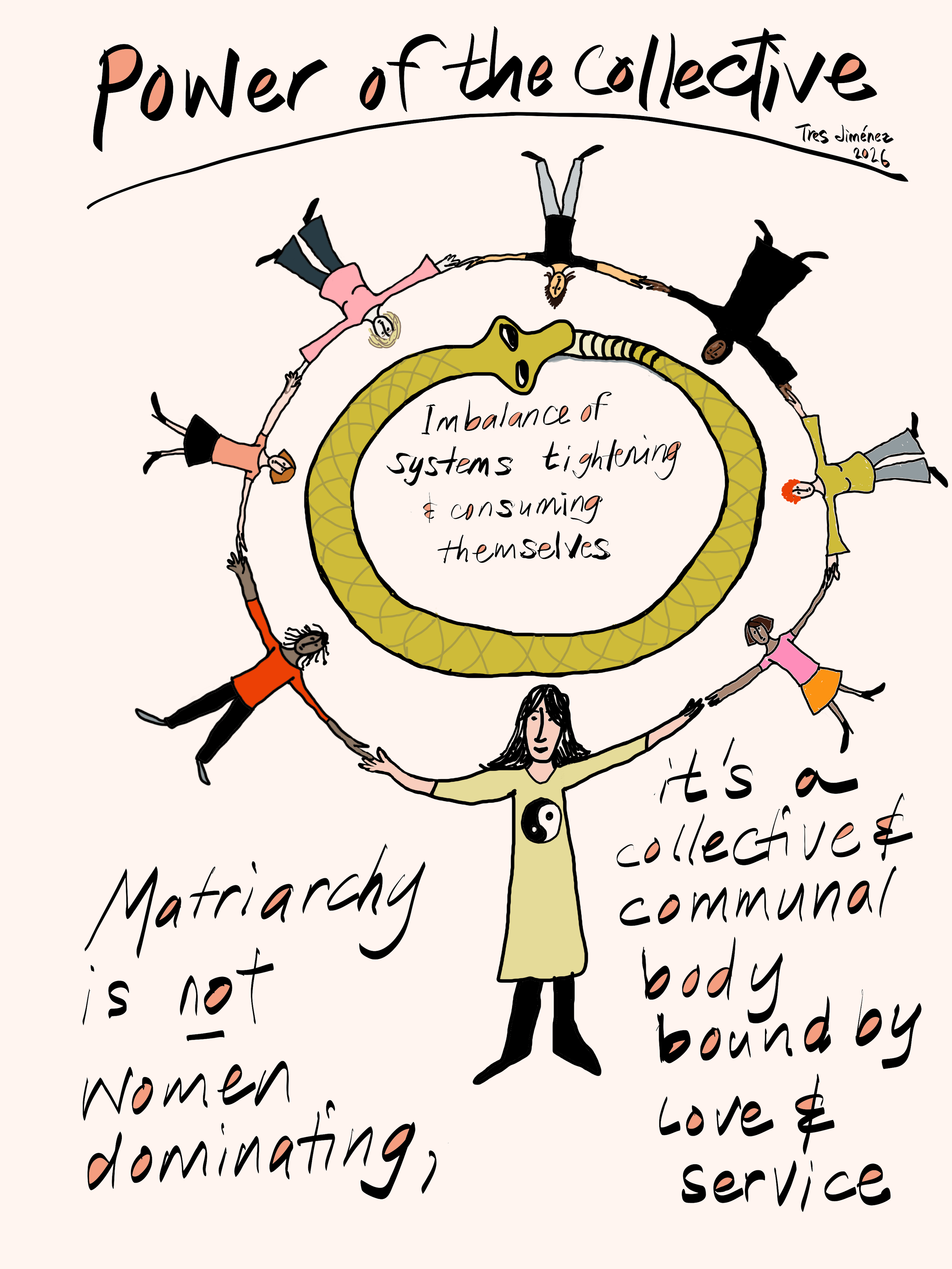
In September I sat with my journal and drew a serpent eating its own tail. The Ouroboros has stood for cycles and renewal for thousands of years. On my page it meant something closer to home: our systems tightening in on their own imbalance until change becomes the way through.
I envision this Ouroboros as a controlling patriarchy crumbling in plain view, and I can see it stuck, consuming itself. Around the serpent I drew a circle of small figures walking together. At the bottom stands a woman with her arms open and a yin-yang at her center. Beside her I wrote what I mean when I say matriarchy: a collective, communal effort bound by love and service.
What matriarchy means to me
People often hear matriarchy as women ruling over men, the old pyramid flipped upside down. The research tells a different story, and it matches what I feel in my bones.
Anthropologist Peggy Reeves Sanday spent years with the Minangkabau of West Sumatra, the largest matrilineal society in the world. She found that their matriarchy places maternal values at the center of life: nurture, consensus, and the wellbeing of the whole community, with men and women both holding essential roles. Heide Göttner-Abendroth, who founded modern matriarchal studies, describes these cultures as egalitarian and built on consensus and sharing. Among the Haudenosaunee, clan mothers choose the chiefs, and they can remove a chief who stops serving the people.
Riane Eisler gave this a name: the partnership model. Power moves around the circle, and everyone in it shares the responsibility for how it is used.
The circle is rising
Look around and you can see the circle forming. Occupy Wall Street movement gathered to say an economy should serve everyone. Black Lives Matter carried grief into the streets and asked who our systems protect. Me Too turned private pain into a public chorus.
This year the circle keeps widening. In Minneapolis, neighbors built rapid response networks and mutual aid in subzero cold after federal immigration agents murdered two civilians. In 2024, seven Cornell fraternity members drugged and violated a fellow student, and people across the nation have rallied to pressure the institutions involved to answer for how they responded and to take accountability for change and action.
Movements grow when someone is willing to speak up. In 1991, Anita Hill testified before an all-male Senate Judiciary Committee about the harassment she reported from her former boss, Clarence Thomas. In 2018, Christine Blasey Ford sat before the same committee to share her account of Brett Kavanaugh. Both paid a price for telling the truth, and both opened the door for the powerful collective voices that followed. This fall, student journalists at The Cornell Daily Sun published the names of the seven men accused in the Cornell case after a two-year investigation. Speaking up lifts the veil, and the circle keeps the speaker from standing alone.
None of these movements has a king at the top. Each moves through shared voices and small acts of care, carried by people of every identity. To me, this is matriarchy in action: leadership by the collective, holding power accountable. Accountability rooted in love asks for truth and repair, and it asks each of us to show up.
A matriarchy of five
When my dad died in 2018, our family changed shape. Since then, my mom, my sisters, and I have led together, the five of us. No one was appointed. We decide by talking, sometimes for a long time, and we lean on whoever holds the strength a moment calls for.
Consensus among five women takes more intention than one person's verdict. I have made peace with that, because what we decide together holds. My family taught me what I bring into every room I facilitate: leadership can be shared, care can be the structure, and the circle is stronger than any one of us.
An invitation
The serpent will keep tightening until the old way lets go. I would rather spend that time building the circle that comes next, with my arms open and my center steady, alongside the people walking with me.
Where in your life are you already part of a circle that leads with love and holds itself accountable?
Further reading
Peggy Reeves Sanday, Women at the Center: Life in a Modern Matriarchy (Cornell University Press, 2002)
Heide Göttner-Abendroth, Matriarchal Societies: Studies on Indigenous Cultures Across the Globe (Peter Lang, 2012)
Riane Eisler, The Chalice and the Blade (1987)
Sally Roesch Wagner, Sisters in Spirit: Haudenosaunee Influence on Early American Feminists (2001)