The Spiral and the Season You're In
The Spiral and the Season You're In A follow-up to On Borrowed Time
Co-authored with Patrick Feehan
If the last essay was about who owns the clock, this one is about what to do when the clock feels like it's working against you.
It started with a brainwave style of conversation with my friend Patrick Feehan. Patrick is the kind of thinker who arrives at ideas the way engineers arrive at elegant solutions — by refusing to accept the first model that almost works. He had been turning over a problem most of us have felt but rarely named: that the common ways we map time through emotional experience are both incomplete and quietly cruel.
The line, he said, is obviously wrong. Life doesn't move from point A to point B with any reliable forward momentum. Anyone who has experienced grief, depression, or a season of real difficulty knows that the line is a lie — or at best, a wish.
But the circle isn't right either. Not because the cycling isn't real — it absolutely is. Anyone who has moved through grief or depression knows the particular cruelty of that loop: a small moment of lightness, even joy, and then the pull back down. The circle captures that rhythm accurately. What it gets wrong is the shape of the container. A closed loop implies you are stuck. That the small happiness was a tease. That the low is waiting to reclaim you, and always will be. That there is no out, only around and around again.
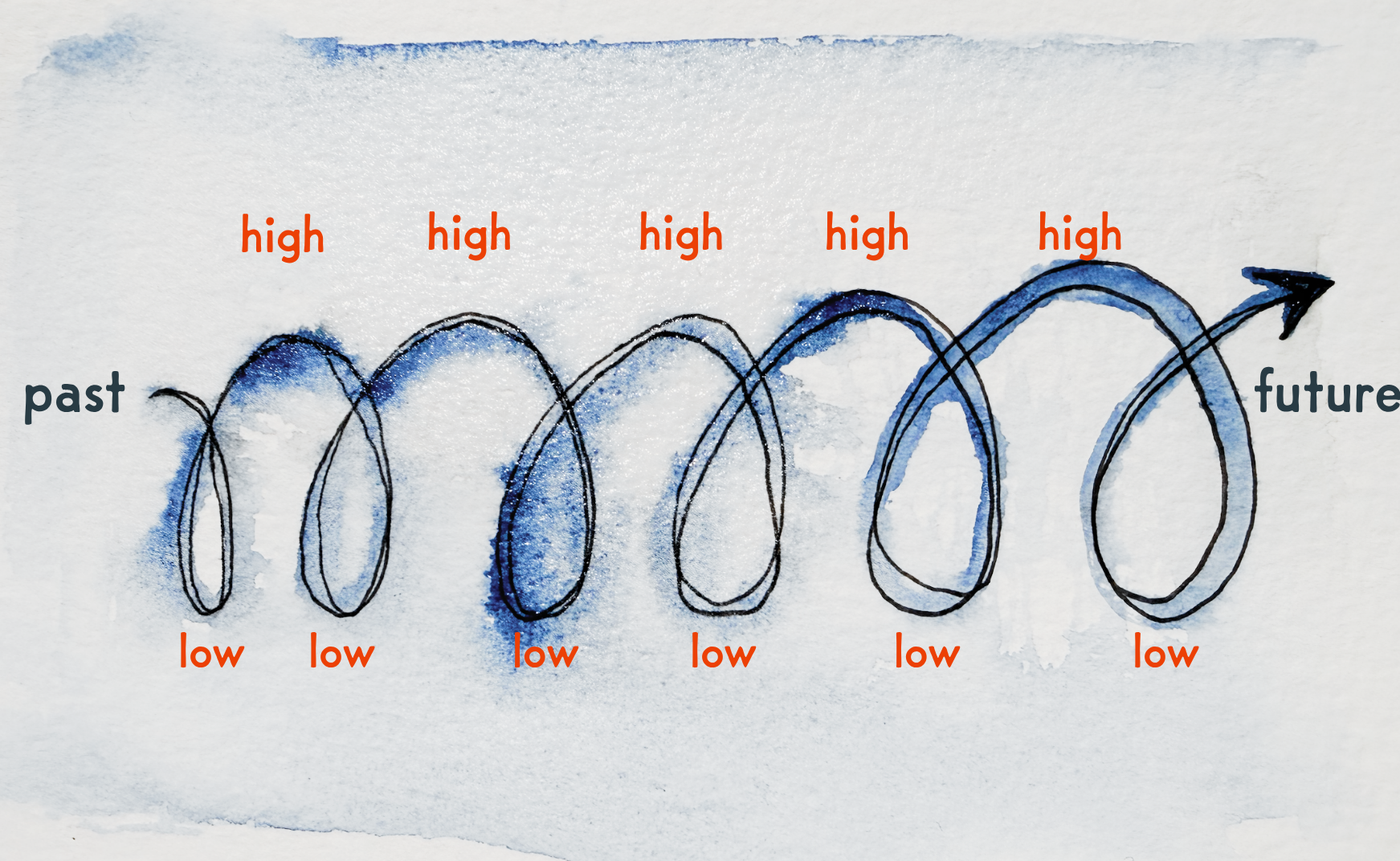
What Patrick proposed is the same motion — the same cycling through highs and lows — but the container is open. It moves forward. The low you are in today is not the same low you were in last time, even when it feels identical. You are processing it from a different place on the path. You have lived more. You have survived the previous descent. The spiral carries you through the familiar emotional territory but deposits you somewhere new — slightly higher, slightly further along, with slightly more capacity than you had before.
The difference between a circle and a spiral is the difference between a cage and a staircase. The motion looks the same from the inside. The destination is entirely different.
Imagine time not as a line stretching forward, and not as a wheel turning in place, but as a helix moving upward — like a spiral staircase, or the structure of DNA, or the nautilus shell that has been a symbol of growth across cultures for centuries. You cycle through high points and low points, yes. You will revisit emotional territory that feels achingly familiar. But you are not in the same place you were the last time you passed through it. You are higher on the spiral. You have more perspective, more accumulated experience, more capacity — even when it doesn't feel that way in the moment.
The low points, in this model, are not failures of the journey. They are not detours or setbacks or evidence that something has gone wrong with you. They are a structural feature of the path itself. The spiral requires the descent as much as the ascent. The processing of pain, grief, loneliness, and difficulty is not time wasted — it is the work that makes the next elevation possible.
Patrick arrived at this not as an abstract philosophical exercise but through his own experience and his own mind — the kind of independent insight that, when you share it with the world, tends to make people say yes, that's exactly it, I just didn't have the words. When I went looking, I found that grief therapists have been drawing spiral models for years, which tells me Patrick is onto something real. But what they describe is narrower — a model for moving through loss. What Patrick's version does is bigger: it applies to the full arc of a human life. Not just grief, but all of it. The professional seasons. The relational tides. The creative droughts and floods. The ordinary Tuesdays that feel impossibly heavy for no reason you can name.
The spiral holds all of it.
That capacity — to observe your own experience with some degree of spaciousness — is something my colleague Sindri Anderson calls healthy detachment. It is not numbing. It is not bypassing. It is the ability to say I am in a low point rather than I am broken. To hold the feeling without being dissolved by it. To remember, even in the dark, that the spiral moves.
The Biorhythm Connection
When Patrick described the spiral, my brain immediately made a lateral move to something I had loved years ago and half-forgotten: biorhythms.
The theory has been around since the early 20th century, when Dr. Herman Svoboda, an Austrian psychologist, began noticing periodic patterns in human behavior — including cyclical patterns in newborns — that led him to identify distinct physical and emotional cycles. In the 1920s, Alfred Teltscher, an engineer and educator, observed a third cycle in his students' intellectual performance and added it to the model. The theory gained mainstream popularity in the 1970s and 1980s, spawned calculators, books, and eventually apps, and then quietly receded from the cultural conversation without ever fully disappearing.
The classical model tracks three primary cycles, each running from your birth date:
Physical — a 23-day cycle governing energy, coordination, strength, and overall vitality. High phase: you feel capable and resilient. Low phase: rest is not laziness, it is intelligence.
Emotional — a 28-day cycle, notably aligned with the lunar cycle, influencing mood, creativity, sensitivity, and relational warmth. High phase: a good day for connection, for difficult conversations that require open-heartedness. Low phase: a good day to be gentle with yourself and perhaps not send that email you drafted at midnight.
Intellectual — a 33-day cycle affecting memory, analytical thinking, communication clarity, and problem-solving. High phase: tackle the complex proposal, the strategic thinking, the writing that requires precision. Low phase: maybe let someone else do the math.
And then there is a fourth cycle that I find most compelling: the intuitive cycle, sometimes called the spiritual or wisdom cycle. During its high phase, trust your gut. During its low phase, rely on logic and the counsel of people you trust. The intuition is resting. Let it.
I want to be honest here: the scientific community has looked at biorhythm theory with considerable skepticism, and the evidence for its predictive precision is not robust. Controlled studies have not consistently confirmed that the cycles reliably forecast performance. So I am not presenting this as hard science.
What I am presenting it as is a useful mirror.
Because the deeper invitation of biorhythm thinking — long before the apps and the calculators — is simply this: you are not a constant. You have natural rhythms across multiple dimensions simultaneously, and those rhythms are not always synchronized. Some days your body is high, your emotions are low, and your intellect is sharp. Some days all three are climbing. Some days you are in a trough across the board, and the most productive thing you can do is acknowledge it and be a little kinder to yourself than usual.
That is not mysticism. That is self-awareness. That is, frankly, what good coaches and wise friends have always known.
The practical question the biorhythm model invites — and the one I still find genuinely useful — is this: what does today actually call for? If your emotional cycle is low, today may not be the day for a vulnerable conversation with someone you love. If your intellectual cycle is high but your physical energy is depleted, do the thinking work from the couch. If your intuition is strong, stop second-guessing yourself and move.
Some of the original apps even allowed you to overlay your biorhythm chart with a partner's — to see where your cycles aligned and where they diverged on any given day. I always found that oddly illuminating. Not as a deterministic guide, but as a prompt for the question: are we both in a good place for this right now? That is a question more relationships could stand to ask more often.
What the Spiral and the Seasons Share
Patrick's spiral and the biorhythm model are pointing at the same essential truth from different directions.
You move in cycles. The low points are not aberrations. They are seasons, and seasons change. The work you do in the difficult passages — the processing, the grieving, the sitting with what is hard — is not time lost. It is altitude gained on the spiral. The next high point will come. And when it does, you will meet it from a different elevation than you did the last time.
Sindri's phrase keeps returning to me here. Healthy detachment. Not distance from your own experience, but enough spaciousness within it to observe where you are without being fully defined by it. To notice: I am in a low emotional season. The spiral is still moving. This is not permanent. This is the structure of the path.
My mother once helped her brother — in a moment of real darkness — simply by pointing to the green grass, the sun, a small dog running in circles for the pure joy of it. Not as a dismissal of his pain, but as evidence that the world was still turning. That the high points exist. That they are real and they return.
That is the spiral in action. That is what it looks like to hold both truths at once — the depth of the low and the certainty of the ascent.
We do not need to rush through the difficult seasons. We do not need to perform recovery or pretend the low points aren't real. We need to move through them with as much presence and self-compassion as we can summon, and to trust — as Patrick does, as Sindri practices, as the spiral insists — that we are not stuck. We are climbing.
Even when it doesn't feel that way.
Especially then.
Read the essay that started this conversation: On Borrowed Time at tresjimenez.com Read the companion piece: The Pivot That Changes Everything