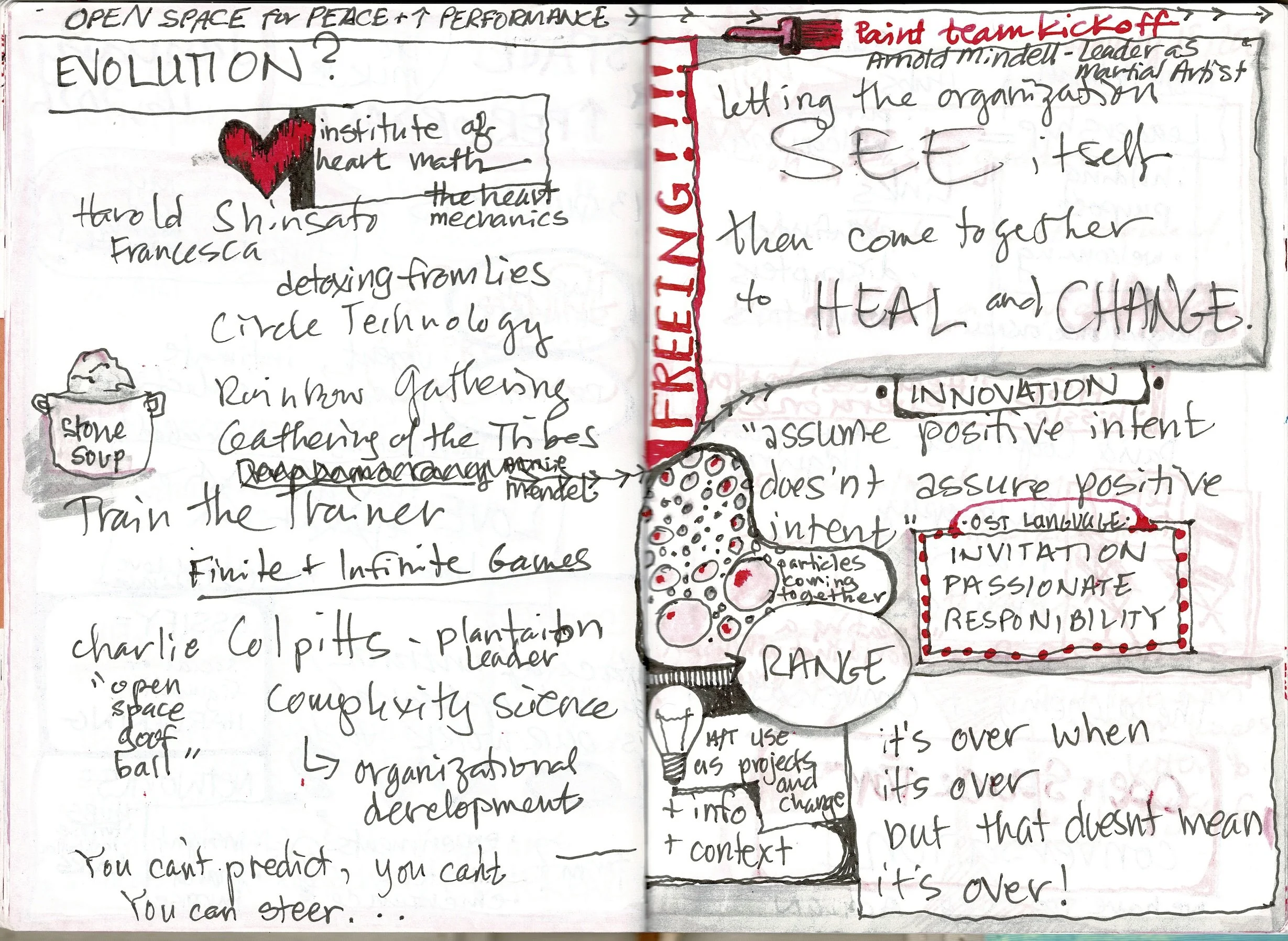
Hubs and Links: Reflections on the Open Space for Peace & High Performance Conference

Last week I spent two days in conversation with practitioners from around the world — Sweden, India, Cincinnati, and points between — all of us exploring a question that feels increasingly urgent:
In the face of untruth, suffering, and upheaval, what is our work to do NOW?
The gathering was convened under the banner of Open Space Technology, a facilitation approach developed by Harrison Owen in the mid-1980s. The origin story is almost too good: Owen noticed that conference attendees consistently reported the coffee breaks as the most valuable part of events — so he designed a format that was essentially all coffee break. No preset agenda. No keynote speakers holding court. Just a circle, a theme, and an invitation for whoever shows up to post the topics they care about and self-organize into conversations. The method has since been used in organizations, communities, and movements across the globe, guided by a few deceptively simple principles: whoever comes are the right people, whatever happens is the only thing that could have, when it starts is the right time, and when it's over, it's over.
The Open Space for Peace & High Performance conference wasn't a typical professional development event. It was a gathering in the oldest sense — people coming together to share stories, ideas, and questions. Which, it turns out, is exactly the point.
Peggy Holman offered a line that's been rattling around in my head ever since:
"Open space is the operating system of the natural world."
Not a methodology we invented. Not a clever facilitation trick. Something more like remembering what humans have always done when they need to figure things out together.
This landed differently than I expected. I came into the conference energized by the doing — the frameworks, the lineages (Harrison Owen's foundational work, David Bohm's dialogue practice, Arnold Mindell's Deep Democracy, bell hooks on love as the antidote to fear and domination). And there's plenty of doing in this tradition. But the throughline that emerged wasn't about action at all.
"We have TOO MUCH action,"
Dr. Rain said at one point during the inspiring conference opener. The real work is listening. Presence. Creating conditions where people can actually hear each other.
I work with organizations that want to accelerate connection and collaboration — and I've learned these aren't the same thing. You can collaborate efficiently without ever really connecting. You can connect deeply and still struggle to move forward together. The magic is in holding both, and that requires a kind of leadership Peggy Holman defined simply as "holding purpose + welcoming."
What struck me most across both days was the image of hubs and links. Hubs provide purpose, welcoming, invitation. Links are the pathfinders, disrupters, connectors who move between them. The whole thing maps to Indra's Net — that ancient metaphor where every node in the web reflects every other node. Nothing exists in isolation. Every conversation ripples outward.
This is where I found fuel.
I've been doing facilitation and coaching work for years, often feeling like I'm pushing a boulder uphill in organizations that default to hierarchy and control. What this gathering reminded me is that I'm not alone. There's a whole world of practitioners — in Sweden and India and Ohio and Denmark and everywhere else — doing this same work. Each of us a hub. Each of us a link. The network forms through experiments, clusters, emergence. Through people helping people find their power and voice. Through invitations to "be musical together." Through the simple act of asking: What's your need? Who can be there?
One question from Day 2 keeps returning to me:
"Am I being supportive — or am I being in the way?"
It's a question for facilitators, yes. But also for anyone trying to help a team, a community, a movement become more than the sum of its parts. Sometimes the most powerful thing you can do is step back and let the system see itself.
The conference closed with an invitation:
"Find your joy, then adjust your life around this."
I'm taking that seriously. This work — helping people gather with purpose, creating spaces where dialogue can happen, building the connective tissue between what is and what could be — this is my joy. And I'm grateful to the clients who trust me with it, who understand that real transformation happens when we slow down enough to actually be with each other.
The work continues. The network grows. And somewhere in the web, another hub lights up, reflecting and connecting to all the others.