Snakes and Superheroes…. When Superheroes Don’t Show Up
Finding Power in the Everyday Work of Super Communities
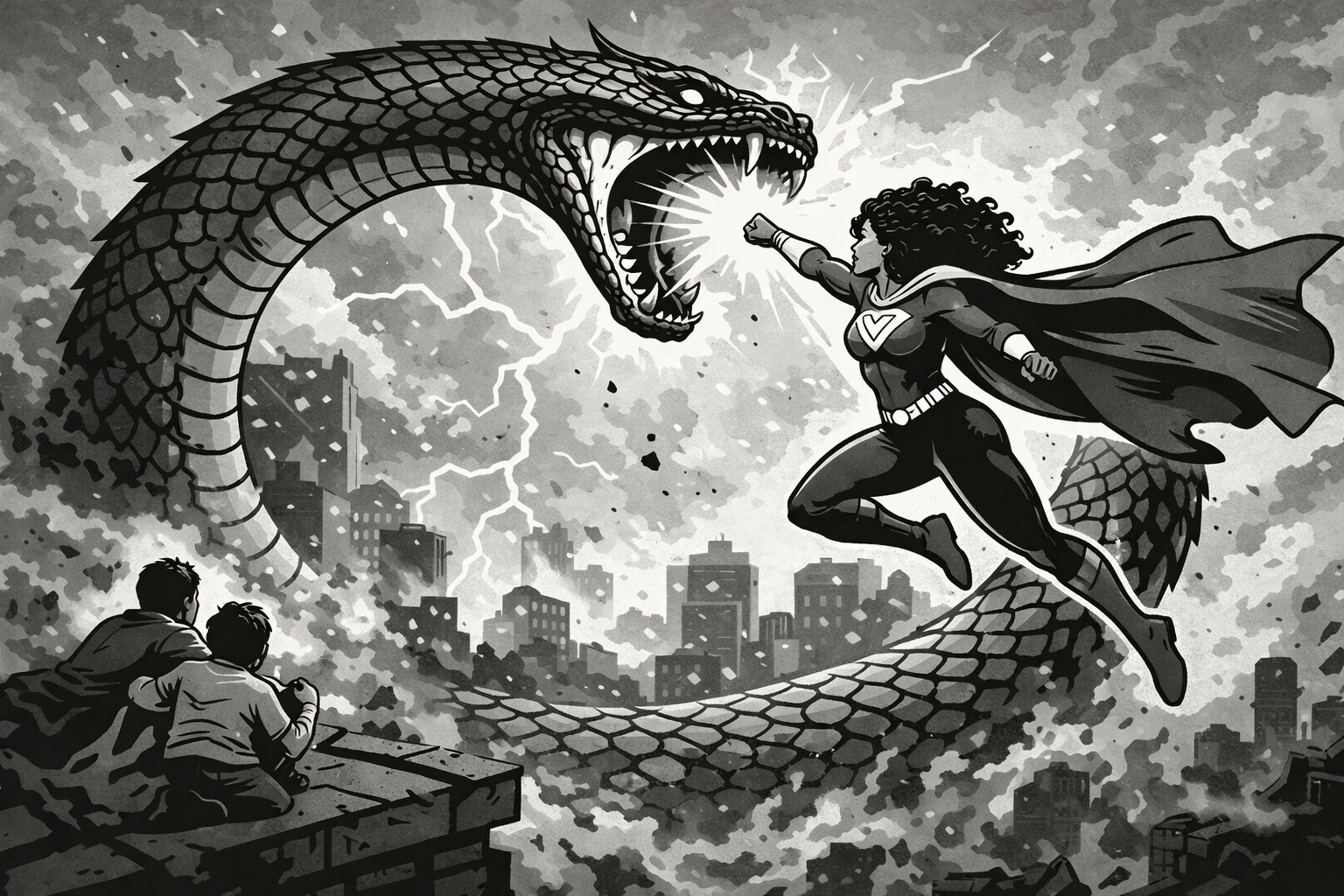
I’ve been thinking about snakes lately.
We’re finishing up the Year of the Snake in the Chinese zodiac, and there’s this ancient symbol—the ouroboros—of a snake consuming its own tail. It represents cycles, destruction and renewal, the beginning that contains the end. And I keep seeing it everywhere right now.
Systems that seemed permanent are eating themselves from the inside. Institutions we thought were solid are revealing their fractures. Leaders who promised strength are turning on each other, pointing fingers, throwing blame. The snake consumes its own tail, and we watch, wondering what comes next.
And I notice something in myself and in conversations with clients and friends: we’re waiting. Waiting for someone to fix this. Waiting for clarity. Waiting for a hero.
The Story We’ve Been Sold
We were raised on superhero movies. I mean this almost literally for some of us, and metaphorically for all of us. Every story we consume tells us the same thing: when the world falls into chaos, someone extraordinary arrives. Someone with special powers, special insight, special courage. They see what others can’t see. They do what others can’t do. And in the nick of time—right when all seems lost—they save us.
Regular people in these stories are bystanders. Victims to be rescued. The crowd that cheers when the hero wins. We’re not the protagonists of our own lives in this narrative. We’re extras waiting for our scene.
And here’s what I’m grieving: I think we’ve been trained to be passive. Trained to scroll and watch and wait for someone else to handle the hard things. Trained to believe that if we’re not extraordinary, we’re not relevant.
The villain part of the story is always easy to see. It’s obvious when power is being consolidated, when fear is being weaponized, when systems are designed to benefit a few at the expense of many. We can all see that movie playing out.
But we keep waiting for the part where the hero flies in.
The Uncomfortable Truth
What if there is no hero coming to save us?
What if the entire framework—the idea that special individuals with exceptional gifts will save us—is part of what got us here? What if democracy was never supposed to be something charismatic leaders deliver to us, but something we practice together, every day, in unglamorous and essential ways?
I’m sitting with this and it feels like grief. Grief for the story I wanted to believe. Grief for the relief that would come with someone wiser and braver stepping forward to handle this. Grief for how much easier it would be to follow than to figure this out together.
And underneath the grief, something else: a kind of stubborn curiosity about what becomes possible when we stop waiting.
The Everyday Superpower
Here’s what I’m noticing in my work with organizations and in my own community: the most important things happening right now aren’t dramatic. They’re not cinematic. Nobody’s writing headlines about them.
They look like:
∙ People learning to have difficult conversations without blowing up relationships
∙ Organizations practicing collaborative decision-making instead of top-down control
∙ Neighbors showing up for each other in practical, repeated ways
∙ Communities experimenting with governance that actually includes everyone
∙ Regular people developing the skills to facilitate, mediate, organize, and build
This is not the stuff of superhero movies. It’s slow. It’s relational. It requires patience and humility and the willingness to stay in relationship with people you disagree with. It means showing up to everyday meetings and doing essential work that no one writes headlines about.
And yet.
Research on how movements succeed and democracies rebuild tells us something consistent: change doesn’t come from exceptional individuals with special powers. It comes from regular people willing to do sustained, collective work. About 3.5% of a population actively and persistently engaged is enough to shift everything.
Not one hero. Not even a handful of leaders. Just enough regular people willing to show up.
Super Communities
Maybe we’re not waiting for superheroes. Maybe we’re becoming something different: super community. Not super as in extraordinary, but super as in connected, sustained, collective.
The prefix “super” means above or beyond. What if what’s beyond the broken systems isn’t a special individual but a different way of being together? What if the power we need isn’t concentrated in exceptional people but distributed among all of us learning to govern ourselves?
I know this doesn’t give us the emotional satisfaction of a hero to follow. It doesn’t compress the timeline into a two-hour arc with a climactic battle and clear resolution. It asks us to tolerate uncertainty and stay engaged even when progress is invisible.
But maybe that’s exactly the work of this snake year. Shedding the old skin—the old story about how change happens—and growing into something that fits what’s actually required now.
The Work in Front of Us
I don’t know how the ouroboros completes its cycle. I don’t know what emerges when the snake finishes consuming itself.
But I’m increasingly convinced that whatever comes next won’t be delivered to us. It will be built by us—in our workplaces and neighborhoods and families and communities. Built through the everyday work of learning to collaborate, to facilitate, to stay in conversation, to make collective decisions, to show up even when it feels pointless.
This isn’t the story I thought I was in. But maybe it’s the true one.
Maybe the superheroes were never coming. Maybe we’re the ones we’ve been waiting for—not because we’re exceptional, but because we’re here, together, willing to do the essential work of building something focused on our collective wellbeing rather than waiting for someone to save us.
The Year of the Snake is ending. Something new is coming. And the most radical thing we might do is stop waiting for someone else to create it.
What are you noticing about the stories you’re waiting for versus the work that’s actually in front of you? I’m curious what emerges when we let go of the hero narrative and lean into our collective capacity.
This photo was taken by Shawnalee Studios. Working with Shawnalee made me feel like a superhero.