When the Interrupter Learns to Listen
When the Interrupter Learns to Listen:
My Journey from Controlling Conversations to Creating Connection
I recognized myself in Linda Howard's recent essay about communication and collaboration, From Miscommunication to Collaboration: How to Bridge Communication Gaps and Build Stronger Teams.
When Linda described her colleague’s 14 year habit of interrupting during conversations, she recalls a particular time when a colleague interrupted yet again and said,
"I know where you're going with this and we've already considered that. Here's why that won't work,"
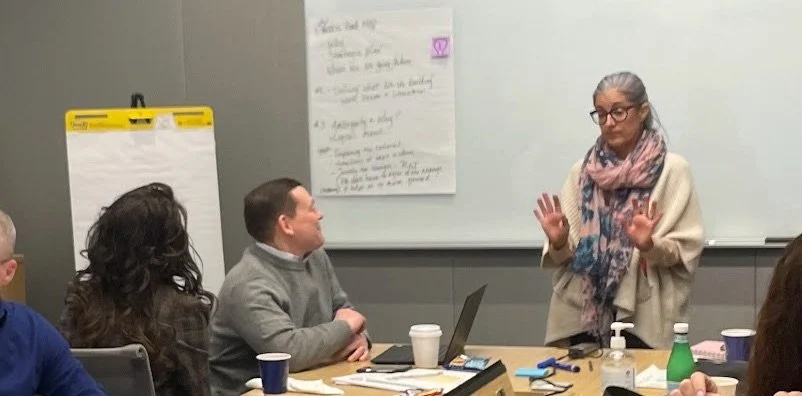
I felt the recognition land in my chest.
That interrupter? That was me.
I felt the recognition land in my chest. That interrupter was me. Not the New York debater with cultural permission to interrupt, but the fast-moving, agenda-driven person who genuinely believed I was being collaborative while actually being controlling.
I used to be the person who finished your sentences. Not because I didn't care what you had to say, but because listening caused my brain to start making connections that would distract my focus from the speaker. My brain would light up with where I thought you were going, and before I knew it, I was racing ahead, steering us both toward what I was certain would be a more creative and interesting destination.
Looking back through the lens of a popular self-assessment that I use in my work with teams called DiSC, I can see it clearly now. My high D or "Dominance" style meant I was direct, fast-paced, and results-oriented. Add in some i or "Influence" energy, and I brought enthusiasm and verbal animation to every exchange. What felt to me like engagement and collaboration probably felt to many people like being steamrolled by someone who wasn't actually interested in their perspective at all.
The thing about being a fast-talking, idea-generating interrupter is that it can work really well in certain contexts. Some people want or match that energy. Some conversations benefit from quick back-and-forth. But here's what I missed for years: what energized me could be exhausting or dismissive to others. What I experienced as collaborative felt controlling to someone with a steadier, more deliberate communication style.
The Anti-Listening Catalog
I've been cataloging the greatest hits of my anti-listening behaviors:
There's the classic sentence-finisher.
The "I know where you're going with this" interrupter.
The conversation redirector who pivots to what I think is more important or interesting.
The assumptive closer who wraps up what you're saying before you've actually said it.
These moves all share something in common: they center my agenda, my timeline, my interpretation. They say "I'm more interested in where I want this to go than where you're taking it."
In her essay, Linda reminds us that our communication styles are shaped by our values and beliefs, our personality and self-concept, culture, how and where we grew up, family relationships, emotional responses, and various experiences. We communicate through these lenses, often not realizing that someone else is looking through an entirely different set of filters. Two people can be talking about the same thing, using language and terminology so differently that we think we're trying to say something totally opposite. I was experiencing "engagement" while my colleagues were experiencing "dismissal" - same conversation, completely different realities.
Using the DiSC framework, we would say that someone with S-style or "Steadiness" preferences values harmony, patience, and being heard without interruption, and my natural communication style probably felt like conversational whiplash. For C-style or "Conscientiousness" colleagues who needed time to process and valued precision, my quick assumptions and redirects likely felt careless and premature.
The Work of Becoming Present
What strikes me most about Linda's story with her colleague Lane is that they worked together for nearly 14 years before having that breakthrough conversation in the breakroom. Fourteen years of frustration that could have been collaboration. Linda writes about wanting to work in an environment where people don't feel they need to leave the room when they don't feel heard or valued. I realize now that I created exactly those moments for others - not through malice, but through my complete lack of awareness about how my "engagement" was shutting people down.
My work now is learning to listen. Actually listen. Not the listening where I'm already formulating my response or identifying the flaw in your logic. Not the listening where I'm waiting for you to take a breath so I can jump in with my better idea.
I'm learning the "tell me more" and "what else" approach. The patient pause. The genuine curiosity about where someone else is actually going, not where I assume they're headed. This requires releasing my ego's need to control the conversation, to be the smartest person in the room, to demonstrate value by steering things in what I think is the right direction.
It's humbling work because I still get it wrong all the time.
The Zoom Mirror and Other Revelations
One unexpected gift of working on Zoom is that I can sometimes watch myself in real time (although I favor turning off my self-view so that I can focus on who is in front of me on my screen). What I've noticed is that I've sometimes overcorrected. In my effort to demonstrate active listening, I've become what might best be described as an antsy child, nodding enthusiastically, making encouraging noises, smiling constantly while someone tells their story.
It's still about me, just in a different way. Instead of interrupting with words, I'm interrupting with my visible, perhaps performative, listening. The storyteller doesn't need my constant affirmation that I'm paying attention. They need me to actually be present with their narrative arc, to mirror their energy rather than constantly emoting my own.
There Is No Formula
Here's what I'm learning: there's no DiSC checklist that will make me the perfect communicator. Knowing my self-assessed preferences doesn't give me a formula to apply to every person I meet. Understanding communication preferences is useful, but it's not a prescription.
Each person in each moment is different. The work is showing up with awareness, caring enough to notice what's happening between us, taking action based on what I observe, and being willing to get it wrong and right and wrong again while continuing to try.
Being present isn't about mastering a technique. It's about genuinely caring enough to set aside my agenda and meet someone where they are. It's about recognizing when my natural style is serving the relationship and when it's serving only my ego.
The Practice of Presence
I still interrupt sometimes. I still finish sentences in my head and have to physically hold myself back from finishing them out loud. The difference now is that I catch myself more often, and when I do interrupt, I can apologize and genuinely mean it.
I'm learning that good communication isn't about suppressing who I am naturally. My directness has value. My enthusiasm matters. My quick thinking serves me and others well in certain contexts.
But good communication also requires me to recognize that what works for me doesn't work for everyone. That someone's slower pace isn't a problem to fix but a rhythm to respect. That silence can be generative rather than awkward. That asking "what else?" might be more valuable than sharing what I think comes next.
Linda emphasizes that workplace relationships and how people view themselves and each other are central to building psychological safety within a team. When I was interrupting and redirecting, I wasn't just being annoying - I was actively undermining psychological safety. I was creating an environment where people couldn't trust that their ideas would be heard fully, where speaking up meant risking being cut off or redirected. The interrupter doesn't just control conversations; they erode the very foundation of trust that teams need to do their best work.
The real work is developing the flexibility to meet people where they are rather than expecting them to match where I am. Sometimes that means leaning into my natural animated energy when speed and decisiveness are needed. Sometimes it means deliberately slowing down, making space, and trusting that someone else's process will get us somewhere valuable, even if it's not where I would have taken us.
Because ultimately, connection isn't about who gets to control the conversation or the destination. It's about being present for the journey together, and caring enough to make sure everyone actually gets to be part of navigating it.